Showing posts with label planet of the facts. Show all posts

Tuesday, 24 July 2012

Planet of the Facts #14: The Fang Rock Feud

FACT No.14: The Fang-Rock Feud

It’s widely known among fandom folk that during their time together on Doctor Who, their was a somewhat tense relationship between Tom Baker (Fourth Doctor) and Louise Jameson (Leela). But it was during the filming of the first serial of Season 15 – ‘Horror of Fang Rock’ – that this took a turning point.

According to Louise Jameson on the DVD commentary of the 1977 story, a scene in Part 3 was crucial to the behind-the-scenes relationship between her and co-star Tom Baker. In one scene, he consistently came in ahead of his cue, upstaging her. On the grounds that this move was "not what they had rehearsed" she insisted on three successive retakes until he came in at the rehearsed time. This apparently won his respect. From that point forward, Jameson says, their working relationship was much smoother.

Ed – *WOOP* for the Planet Of The Facts’ title refurb! Classic Who font’n’everything.

Saturday, 14 July 2012

Planet of the Facts #13: Time Lord Society – VOLUME 2. The Hierarchy

FACT No.13: TIME LORD SOCIETY

- VOLUME TWO – The Hierarchy -

The hierarchy of the significant figures in Time Lord society was largely devised by Robert Holmes in his 1977 story ‘The Deadly Assassin’, which was continued and added to in the 1978 Fourth Doctor (Tom Baker) serial ‘The Invasion of Time’. The presentation of the Time Lord hierarchical system was, in fact, inspired by the United States Constitution’s separation of powers.

This system guarantees the independence of the three branches of government, in order to prevent abuse of power by anyone. In Time lord society, these three vital roles of government – or the Citadel, in the case of Gallifrey – are filled by a Castellan (chief of the Citadel and Gallifreyan security, and second-in-line to the Presidency and second-in-command), a Chancellor (advisor to the President and third-in-line), and then the President himself; the highest authority and power on Gallifrey.

Another figure of Gallifreyan Time Lord society is the ‘Gold Usher’. The Gold Usher was conceived as a title devoted purely to ceremonial duties, such as the Presidential inauguration in ‘The Invasion of Time’. His role in the Citadel was compared by the production team to the Black Rod in the British Parliament, again purely ceremonial.

Friday, 13 July 2012

Planet of the Facts #12: Time Lord Society–VOLUME ONE. The Panopticon

FACT No.12: TIME LORD SOCIETY

- VOLUME ONE – The Panopticon -

The word “Panopticon” by philosopher Jeremy Bentham (from whom writer Robert Holmes got the name for the room’s first appearance in ‘The Deadly Assassin’) in 1787. The word has its etymological roots in Greek, translating vaguely as “everything seen”. Bentham gave the word as a title for a (at the time, new) style of circular prison, in which the inmates could be constantly watched over, hence the translation.

Within the context of Doctor Who, however, the Panopticon is a large viewing room inside the Citadel of the Time Lords, on Gallifrey, generally used as a place of ceremony, such as Presidential inaugurations (as seen in ‘The Deadly Assassin’ and ‘The Invasion of Time’ – see below).

The Panopticon in 'The Invasion of Time', as the Doctor is inaugurated as President of Gallifrey.

Sunday, 8 July 2012

Planet of the Facts #11: Rose Tyler Earth Defence

articleimageTV_058FACT No.11: Rose Tyler Earth Defence

After Rose (Billie Piper) was written out of Doctor Who at the end of Series 2 ‘Doomsday’, Russell T Davies considered giving the character her own 90-minute spin-off production, Rose Tyler: Earth Defence, with the possibility of such a special becoming an annual Bank Holiday event.

Although the special was officially commissioned, Davies changed his mind and decided that such a return, wherein the audience would be able to see Rose when the Doctor could not, would spoil her final scenes in Doctor Who. The production was consequently cancelled.

Saturday, 7 July 2012

Planet of the Facts #10: Multiple Jacks

articleimageTV_057FACT No.10: Multiple Jacks

If the events of Torchwood and Doctor Who are considered together, there are four different versions of Captain Jack Harkness in the World War II time period. Here they are in chronological order of his own timeline…

JACK #1 is his appearance in Doctor Who ‘The Empty Child’/‘The Doctor Dances’; his significant first encounter with the Ninth Doctor and Rose Tyler. The night that changed his life!

JACK #2 appeared via Vortex Manipulator in 1869 London (part-seen in Torchwood ‘Fragments’), following the events of ‘The Parting of the Ways’. The device short-circuited and the teleportation was left unusable, which meant he lived through World War II once again, part of which we glimpsed in flashbacks featured in Torchwood: Children of Earth.

JACK #3 is the Jack seen in the Torchwood episode ‘Captain Jack Harkness’ in Series 1 in which he is sent back in time to this period with Toshiko.

JACK #4, however, is significantly less mobile as this time round he was buried alive in 27 AD (Torchwood ‘Exit Wounds’), only to be dug up in 1901 by Torchwood and put in a cryo-chamber with instructions to be defrosted/woken in 2009. Therefore, this fourth WW2 Jack was frozen throughout the time period that all the others were wandering around.

Friday, 6 July 2012

Planet of the Facts #9: Origins of the Toclafane

FACT No.9: Origins of the Toclafane

Nobody can accuse Russell T Davies of not planning ahead. In 2004, when (along with other episodes) the script for ‘Dalek’ was being re-drafted, at one point it became apparent that they may not be able to get the rights to use the Daleks at all. In this event, Davies and writer Robert Shearman drafted a new version of the script, replacing the lone Dalek with a captive metal sphere that was then only known in the script as “Sphere”.

Shearman describes how Davies proposed the replacement monster idea, drawing a simple circle of the Sphere on paper, saying: “I’m bringing this forward from what I imagined the end of Series Three might be.” Shearman says, “At that stage we hadn’t shot anything of Series One, so this was Russell with his long-term plan which he would never otherwise discuss.” The idea was that it would have housed a “remnant head”, with a “childlike sing-song voice” and was a future evolution of the human race that had destroyed the Time Lords (this was the plan for the ‘Sphere’-version of the Time War). The lone Sphere was to have fallen through a rift above Utah and held captive by Henry Van Statten.

postpic_PotF-ToclafaneSketch_thumb16

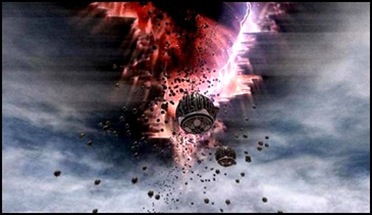
Later, of course, they gained the rights clearance from the Terry Nation estate to use the Daleks, eventually resulting in the episode ‘Dalek’ we know and love today, but the “Sphere” (originally planned as a Series Three finale enemy) remained where it had initially been planned. It went on the become the Toclafane, aiding the John Simm Master in his conquest of planet Earth. The idea of the Sphere falling through a Rift became the millions-strong swarm of Toclafane flying through the Paradox Rift (see below) – the cliffhanger ending of ‘The Sound of Drums’.
PlanetOfTheFacts_button0154444494

With thanks to Robert Shearman and Doctor Who Magazine. Source: DWM-449.

Thursday, 5 July 2012

Planet of the Facts #8: Mawdryn Undead Return

PlanetOfTheFacts_footer015555555articleimageTV_056FACT No.8: Mawdryn Undead Return

The initial intention of John Nathan Turner for a significant returning character, for the 1983 serial ‘Mawdryn Undead’, was First Doctor companion Ian Chesterton, played by William Russell; he had played the part from Doctor Who’s very beginning in 1963 to 1965. He was to have returned for a guest appearance in this Fifth Doctor story, hence the school setting, as Ian had been a science teacher.

Unfortunately, however, actor William Russell was not available for the filming schedule required, so JNT shifted his gaze to other male companions from the show’s history. Some consideration was given to using Harry Sullivan (played by Ian Marter), who was a regular for one series (alongside the Fourth Doctor and Sarah Jane). However, once the production team discovered they could hire Nicholas Courtney for another appearance as Brigadier Lethbridge-Stewart, they decided upon him.

Wednesday, 4 July 2012

Planet of the Facts #7: A Half-Human Doctor

FACT No.7: A Half-Human Doctor

The original concept for the 1996 TV movie’s plot was to not only introduce the idea that The Doctor was apparently human, but also involved the newly-regenerated Eighth Doctor (played by Paul McGann) to go searching for his true father, who was to have appeared and been an integral part of the plot.

Through the filtering of the various TV companies’ wants and many script drafts later, this plotline was reduced to a couple of lines – one said by The Master (Eric Roberts) and the other by The Doctor himself – mentioning he is “half-human”; these lines remain as it was the one idea that producer Philip Segal was very adamant to retain of the initial script.

The Doctor’s human-Gallifreyan parentage idea was inspired by Mr Spock’s half-human parentage in Star Trek.

With thanks to Niall Boyce.

Tuesday, 3 July 2012

Planet of the Facts #6: The Nation’s Dalek Naming

FACT No.6: The Nation’s Dalek Naming

The word “Dalek” actually translates as “a far and distant place” in Serbo-Croatian, although this was, in fact, a complete coincidence on Terry Nation’s part (the creator of the Daleks, if you didn’t know… somehow).

Nation originally told a Daily Mirror journalist in 1964, the name of the Dalek came from a dictionary or encyclopaedia volume, the spine of which apparently read "…dal – Lek…". Years later, however, he admitted this story was entirely fictitious. In reality, the word had randomly rolled from his typewriter as a typographical mistake.

According to director Kevin Davies – in his 1993 book ‘More Than 30 Years In The TARDIS’, Terry Nation was later pleasantly surprised when informed of his creation’s Serbo-Croatian meaning.

Monday, 2 July 2012

Planet of the Facts #5: Felicity Kendal

FACT No.5: Felicity Kendal

Just like her character in the 2008 Series Four episode ‘The Unicorn and the Wasp’ (Lady Eddington of Eddington Hall, in the story written by Gareth Roberts), Felicity Kendal was born the UK, but moved with her parents to India at a very young age. As a result, again like Lady Eddington, Kendal grew up in India and moved back to the UK when in her twenties.

Sunday, 1 July 2012

Planet of the Facts #4: The Dalek Timelash

FACT No.4: The Dalek Timelash

The 1985 Sixth Doctor (Colin Baker) and Peri (Nicola Bryant) two-part serial ‘Timelash’ was originally submitted by writer Glen McCoy to script editor Eric Saward as a Dalek story. However, the script was rejected as Saward didn’t think it a suitable plot for The Doctor’s ultimate foe.

The script editor then invited McCoy to re-submit a thoroughly re-drafted version, not including the Skaro-born aliens, which resulted in the ‘Timelash’ story we know today.

Saturday, 30 June 2012

Planet of the Facts #3: Boom Town

articleimageTV_045FACT No.3: Boom Town

Russell T Davies wrote this episode specifically for actress Annette Badland (who played ‘Margaret Slitheen’ in human form) after watching her performance in the rushes' footage from the filming for episodes 4 and 5 ('Aliens of London' and 'World War Three'), which were the first episodes of Series One to be filmed.

Friday, 29 June 2012

Planet of the Facts #2: Open-top TARDIS

articleimageTV_044FACT No.2: Open-top TARDIS

You might think that The Doctor and Idris’ makeshift TARDIS travelling would be suicidal with a distinct lack of protective walls, but The Doctor has travelled this way before.

In the 1970 serial ‘Inferno’, the Third Doctor (Jon Pertwee) broke the mould by also travelling via ‘open-top’ TARDIS with the disconnected console of his time machine, in order to travel between our universe and the infamous parallel universe featured in the story.

Thursday, 28 June 2012

Planet of the Facts #1: Susan Foreman

FACT No.1: SUSAN FOREMAN

The character of Susan Foreman was originally not envisioned by creators Sydney Newman and Verity Lambert as  any relation to The Doctor, but the producers felt uneasy with the sexual connotations that would have come with an elderly gentleman keeping a teenage girl for his companion.

PlanetOfTheFacts_button01

Do you want Christopher Eccleston back for the 50th Anniversary?
YES!! - That would be absolutely brilliant!
Not sure - I'm not bothered either way, to be honest...
No - it's good to see the back of 'im!
Create your own poll
Twitter Bird Gadget